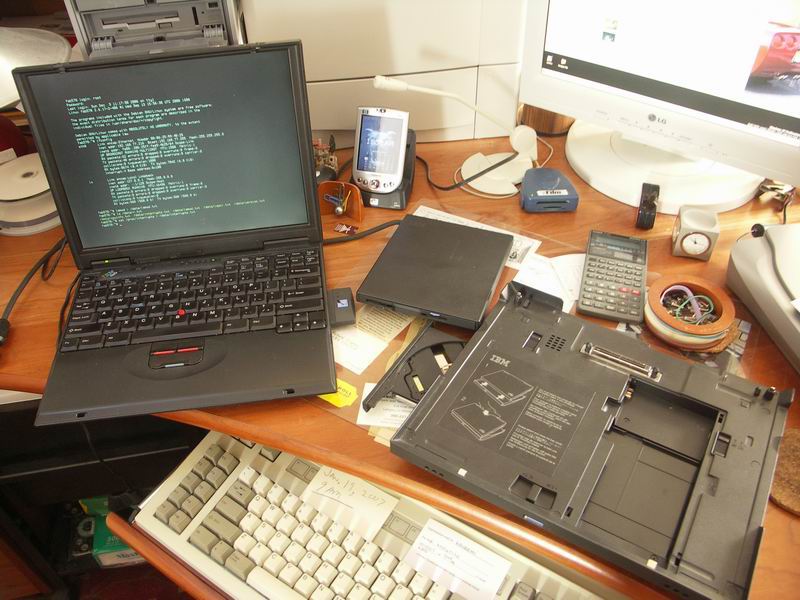
PII 366MHz (256KB)
192MB RAM
6.4GB Hd IBM-DBCA-206480
13.3 XGA TFT
Cirrus Logic 4614/22/24 Crystal Soundfusion Audio
Neomagic Corporation NM2200 [MagicMedia 256AV]
24X CD (SANYO CRD-S372BVA)
CardBus bridge: Texas Instruments PCI1250 (rev 03)
IDE/USB Controller: Intel Corp. 82371AB/EB/MB PIIX4 USB (rev 01)
Serial connector (EIA-RS232D)
Parallel connector (IEEE 1284A)
External input-device connector
External-monitor connector
External-diskette-drive connector
Expansion connector
PC Card slots (two Type I or Type II PC Cards, or one Type III PC Card)
Headphone jack
Microphone jack
Line-in jack Infrared port
Universal serial bus (USB) connector
Telephone connector
Ultrabase Features
* UltraslimBay
* Diskette-drive/Battery Bay
* Ports
* Stereo line out
* Game/MIDI
* USB
* Ergonomics
* Security keyhole
* UltraBase Lock
* Hot/warm/cold docking support (Windows 95 and 98)
* Cold docking support (Windows NT)
* Built-in stereo speakers
* Status LED
* Eject event switch
I purchased this machine to replace the 390 as a 'spare' machine. The native OS was Windows 98 or 2000, but it came with Windows ME™ installed, and I have decided to keep that, for now. (Call it nostalgia, or masochism.) I did make room for a small PC-DOS setup, BootMagic™ as a boot manager, and of course, a Linux partition. The machine came with a grab bag of extras, including a small USB 10/100 ethernet plug, which turns out to be a Realtek 8150 chip, and works fine. Other miscellaneous items including a dual 2.0 USB port I sold off.
The key reason I chose this machine is that the separate Ultrabase™ makes the unit very versatile. The CPU by itself is very light, but has no spindles. There is a custom floppy port for an external drive (which I added to update the BIOS, which requires you to remove the UltraBase) and there is a space for either a floppy or second battery in the Ultrabase™. There is another bay in the base which can hold a CDROM or a DVD or a CDRW/DVD combo. Mine came with a CDROM and I've bought a DVD. Since the PII runs at 366 Mhtz, it is more or less able to play commercial, standard DVD's OK, but the older DVD drive I bought can't handle data DVD's produced by a burner. Bummer.
The biggest physical liability is that the screen bezel is cracked a bit at one corner and the hinge connection is a little flaky, so you have to play with the screen hinge a bit to find a stable position where you don't get various psychedelic manifestations flashing on the screen. All in all, however, the light weight (without the base), full VGA screen and borderline-but-sufficient CPU make this much more useful 'spare' than the 390 is/was. Not bad for $81 on eBay.
My initial experience with Debian Etch was pretty good. With BootMagic™ as a boot manager. Debian Etch (as of 12/06) can boot from LILO installed in the local partition, although you have to force the installer not to install GRUB first. Most of the time for ethernet I'm using a Linksys WPC11 version 3. (The machine also came with a Linksys WPC11 version 4 card, which works fine in Windows but not at all in any out-of-the-box linux.) The video is basically the same as the 390, but the audio worked much more cleanly on the CS46XX. XOrg and ALSA worked out-of-the-box, and my wireless card was more or less reliable, although it would occasionally fail to come up, maybe one out of ten boots.
To try to clean up a bit I did one last upgrade, pulled down the latest 2.6.18 kernel, and the system basically broke. Apparently there are well-documented UDEV problems with removable devices, and for me, this mean that my wireless card now failed to come on most of the time [UDEV Link Not Ready... look that up.]. I read through all the forums and tried all the latest work-arounds, some of which are being built into the daily Etch builds, but all to no avail. What a pain. So, in frustration, I have downgraded back to Sarge, 2.6.8 kernel. The system is now very stable and reliable. The machine is just quick enough for everyday use, and is running my more or less standard Windowmaker desktop.
I still may decide to replace Debian with Ubuntu, to get OpenOffice 2.0, Gambas and a few other goodies for which I'd need Debian Etch. Or I may wait for the Debian team to fix UDEV. Anyway, as of 12/06, here is some diagnostic output:
dmesg
Linux version 2.6.8-3-686 (pbuilder@dl360-g3) (gcc version 3.3.5 (Debian 1:3.3.5-13)) #1 Tue Dec 5 21:26:38 UTC 2006 BIOS-provided physical RAM map: BIOS-e820: 0000000000000000 - 000000000009fc00 (usable) BIOS-e820: 000000000009fc00 - 00000000000a0000 (reserved) BIOS-e820: 00000000000e0000 - 0000000000100000 (reserved) BIOS-e820: 0000000000100000 - 000000000bff0000 (usable) BIOS-e820: 000000000bff0000 - 000000000bfffc00 (ACPI data) BIOS-e820: 000000000bfffc00 - 000000000c000000 (ACPI NVS) BIOS-e820: 00000000ffff0000 - 0000000100000000 (reserved) 0MB HIGHMEM available. 191MB LOWMEM available. On node 0 totalpages: 49136 DMA zone: 4096 pages, LIFO batch:1 Normal zone: 45040 pages, LIFO batch:10 HighMem zone: 0 pages, LIFO batch:1 DMI 2.2 present. ACPI disabled because your bios is from 99 and too old You can enable it with acpi=force Built 1 zonelists Kernel command line: auto BOOT_IMAGE=Linux ro root=304 Local APIC disabled by BIOS -- reenabling. Could not enable APIC! Initializing CPU#0 PID hash table entries: 1024 (order 10: 8192 bytes) Detected 365.179 MHz processor. Using tsc for high-res timesource Console: colour dummy device 80x25 Dentry cache hash table entries: 32768 (order: 5, 131072 bytes) Inode-cache hash table entries: 16384 (order: 4, 65536 bytes) Memory: 186960k/196544k available (1553k kernel code, 8956k reserved, 689k data, 148k init, 0k highmem) Checking if this processor honours the WP bit even in supervisor mode... Ok. Calibrating delay loop... 718.84 BogoMIPS Security Scaffold v1.0.0 initialized Mount-cache hash table entries: 512 (order: 0, 4096 bytes) CPU: After generic identify, caps: 0183f9ff 00000000 00000000 00000000 CPU: After vendor identify, caps: 0183f9ff 00000000 00000000 00000000 CPU: L1 I cache: 16K, L1 D cache: 16K CPU: L2 cache: 256K CPU: After all inits, caps: 0183f9ff 00000000 00000000 00000040 Intel machine check architecture supported. Intel machine check reporting enabled on CPU#0. CPU: Intel Mobile Pentium II stepping 0a Enabling fast FPU save and restore... done. Checking 'hlt' instruction... OK. checking if image is initramfs...it isn't (ungzip failed); looks like an initrd Freeing initrd memory: 4556k freed NET: Registered protocol family 16 PCI: PCI BIOS revision 2.10 entry at 0xfd96f, last bus=10 PCI: Using configuration type 1 mtrr: v2.0 (20020519) ACPI: Subsystem revision 20040326 ACPI: Interpreter disabled. Linux Plug and Play Support v0.97 (c) Adam Belay PnPBIOS: Scanning system for PnP BIOS support... PnPBIOS: Found PnP BIOS installation structure at 0xc00f6d30 PnPBIOS: PnP BIOS version 1.0, entry 0xf0000:0x90aa, dseg 0x400 pnp: 00:06: ioport range 0x15ea-0x15ef has been reserved pnp: 00:08: ioport range 0x4d0-0x4d1 has been reserved pnp: 00:08: ioport range 0x1000-0x103f has been reserved pnp: 00:08: ioport range 0x1040-0x104f has been reserved PnPBIOS: 20 nodes reported by PnP BIOS; 20 recorded by driver PCI: Probing PCI hardware PCI: Probing PCI hardware (bus 00) PCI: Using IRQ router PIIX/ICH [8086/7110] at 0000:00:06.0 VFS: Disk quotas dquot_6.5.1 Dquot-cache hash table entries: 1024 (order 0, 4096 bytes) devfs: 2004-01-31 Richard Gooch (rgooch@atnf.csiro.au) devfs: boot_options: 0x0 Initializing Cryptographic API Limiting direct PCI/PCI transfers. isapnp: Scanning for PnP cards... isapnp: No Plug & Play device found Serial: 8250/16550 driver $Revision: 1.90 $ 48 ports, IRQ sharing enabled pnp: Device 00:12 activated. ttyS0 at I/O 0x3f8 (irq = 4) is a 16550A RAMDISK driver initialized: 16 RAM disks of 8192K size 1024 blocksize serio: i8042 AUX port at 0x60,0x64 irq 12 serio: i8042 KBD port at 0x60,0x64 irq 1 input: AT Translated Set 2 keyboard on isa0060/serio0 NET: Registered protocol family 2 IP: routing cache hash table of 1024 buckets, 8Kbytes TCP: Hash tables configured (established 16384 bind 32768) NET: Registered protocol family 8 NET: Registered protocol family 20 RAMDISK: cramfs filesystem found at block 0 RAMDISK: Loading 4556 blocks [1 disk] into ram disk... one. VFS: Mounted root (cramfs filesystem) readonly. Freeing unused kernel memory: 148k freed vesafb: framebuffer at 0xf5000000, mapped to 0xcc81c000, size 2496k vesafb: mode is 1024x768x16, linelength=2048, pages=0 vesafb: protected mode interface info at c000:a6d0 vesafb: scrolling: redraw vesafb: directcolor: size=0:5:6:5, shift=0:11:5:0 fb0: VESA VGA frame buffer device Console: switching to colour frame buffer device 128x48 NET: Registered protocol family 1 Uniform Multi-Platform E-IDE driver Revision: 7.00alpha2 ide: Assuming 33MHz system bus speed for PIO modes; override with idebus=xx PIIX4: IDE controller at PCI slot 0000:00:06.1 PIIX4: chipset revision 1 PIIX4: not 100% native mode: will probe irqs later ide0: BM-DMA at 0x1800-0x1807, BIOS settings: hda:DMA, hdb:pio ide1: BM-DMA at 0x1808-0x180f, BIOS settings: hdc:pio, hdd:pio hda: IBM-DBCA-206480, ATA DISK drive Using anticipatory io scheduler ide0 at 0x1f0-0x1f7,0x3f6 on irq 14 hda: max request size: 128KiB hda: 12594960 sectors (6448 MB) w/420KiB Cache, CHS=13328/15/63, UDMA(33) /dev/ide/host0/bus0/target0/lun0: p1 p2 p3 < p5 p6 > p4 hdc: CRN-8241B, ATAPI CD/DVD-ROM drive ide1 at 0x170-0x177,0x376 on irq 15 ext3: No journal on filesystem on hda4 Adding 136040k swap on /dev/hda6. Priority:-1 extents:1 Generic RTC Driver v1.07 hdc: ATAPI 24X CD-ROM drive, 128kB Cache, DMA Uniform CD-ROM driver Revision: 3.20 input: PS/2 Generic Mouse on isa0060/serio1 Capability LSM initialized device-mapper: 4.1.0-ioctl (2003-12-10) initialised: dm@uk.sistina.com mice: PS/2 mouse device common for all mice ts: Compaq touchscreen protocol output Linux agpgart interface v0.100 (c) Dave Jones Linux Kernel Card Services options: [pci] [cardbus] [pm] PCI: Found IRQ 11 for device 0000:00:02.0 PCI: Sharing IRQ 11 with 0000:00:05.0 PCI: Sharing IRQ 11 with 0000:01:00.0 Yenta: CardBus bridge found at 0000:00:02.0 [1014:0130] Yenta: Using INTVAL to route CSC interrupts to PCI Yenta: Routing CardBus interrupts to PCI Yenta TI: socket 0000:00:02.0, mfunc 0x00001000, devctl 0x66 Yenta: ISA IRQ mask 0x06f8, PCI irq 11 Socket status: 30000010 PCI: Found IRQ 11 for device 0000:00:02.1 Yenta: CardBus bridge found at 0000:00:02.1 [1014:0130] Yenta: Using INTVAL to route CSC interrupts to PCI Yenta: Routing CardBus interrupts to PCI Yenta TI: socket 0000:00:02.1, mfunc 0x00001000, devctl 0x66 spurious 8259A interrupt: IRQ7. Yenta: ISA IRQ mask 0x06f8, PCI irq 11 Socket status: 30000006 usbcore: registered new driver usbfs usbcore: registered new driver hub USB Universal Host Controller Interface driver v2.2 PCI: Found IRQ 11 for device 0000:00:06.2 uhci_hcd 0000:00:06.2: Intel Corp. 82371AB/EB/MB PIIX4 USB uhci_hcd 0000:00:06.2: irq 11, io base 00001820 uhci_hcd 0000:00:06.2: new USB bus registered, assigned bus number 1 hub 1-0:1.0: USB hub found hub 1-0:1.0: 2 ports detected usb 1-1: new full speed USB device using address 2 hub 1-0:1.0: over-current change on port 2 SCSI subsystem initialized Initializing USB Mass Storage driver... scsi0 : SCSI emulation for USB Mass Storage devices Vendor: USB Model: Flash Disk Rev: 7.77 Type: Direct-Access ANSI SCSI revision: 02 USB Mass Storage device found at 2 usbcore: registered new driver usb-storage USB Mass Storage support registered. SCSI device sda: 256000 512-byte hdwr sectors (131 MB) sda: assuming Write Enabled sda: assuming drive cache: write through /dev/scsi/host0/bus0/target0/lun0: p1 Attached scsi removable disk sda at scsi0, channel 0, id 0, lun 0 agpgart: Detected an Intel 440BX Chipset. agpgart: Maximum main memory to use for agp memory: 149M agpgart: AGP aperture is 64M @ 0xf8000000 cpci_hotplug: CompactPCI Hot Plug Core version: 0.2 pci_hotplug: PCI Hot Plug PCI Core version: 0.5 pciehp: acpi_pciehprm:get_device PCI ROOT HID fail=0x1001 shpchp: acpi_shpchprm:get_device PCI ROOT HID fail=0x1001 PCI: Found IRQ 11 for device 0000:00:05.0 PCI: Sharing IRQ 11 with 0000:00:02.0 PCI: Sharing IRQ 11 with 0000:01:00.0 input: PC Speaker inserting floppy driver for 2.6.8-3-686 Floppy drive(s): fd0 is 1.44M FDC 0 is a National Semiconductor PC87306 irda_init() NET: Registered protocol family 23 parport: PnPBIOS parport detected. parport0: PC-style at 0x3bc, irq 7 [PCSPP,TRISTATE] IBM machine detected. Enabling interrupts during APM calls. apm: BIOS version 1.2 Flags 0x03 (Driver version 1.16ac) cs: IO port probe 0x0100-0x04ff: clean. cs: IO port probe 0x0800-0x08ff: clean. cs: IO port probe 0x0c00-0x0cff: clean. cs: IO port probe 0x0a00-0x0aff: clean. cs: memory probe 0xa0000000-0xa0ffffff: clean. orinoco.c 0.13e (David Gibson and others) orinoco_cs.c 0.13e (David Gibson and others) eth0: Station identity 001f:0005:0001:0003 eth0: Looks like an Intersil firmware version 1.3.5 eth0: Ad-hoc demo mode supported eth0: IEEE standard IBSS ad-hoc mode supported eth0: WEP supported, 104-bit key eth0: MAC address 00:06:25:A9:4B:25 eth0: Station name "Prism I" eth0: ready eth0: index 0x01: Vcc 5.0, irq 3, io 0x0100-0x013f NET: Registered protocol family 10 Disabled Privacy Extensions on device c0300140(lo) IPv6 over IPv4 tunneling driver eth0: New link status: Connected (0001) NET: Registered protocol family 17 eth0: no IPv6 routers present eth0: New link status: Disconnected (0002) eth0: New link status: Connected (0001)
lsmod
Module Size Used by
orinoco_cs 9320 1
orinoco 44140 1 orinoco_cs
hermes 8640 2 orinoco_cs,orinoco
af_packet 22600 2
ipv6 265124 8
ds 18756 5 orinoco_cs
apm 21100 1
parport_pc 36900 0
parport 41800 1 parport_pc
irtty_sir 9152 0
sir_dev 19212 1 irtty_sir
irda 197536 2 irtty_sir,sir_dev
crc_ccitt 2144 1 irda
floppy 61200 0
pcspkr 3592 0
snd_cs46xx 91976 0
snd_rawmidi 25124 1 snd_cs46xx
snd_seq_device 8200 1 snd_rawmidi
snd_ac97_codec 69988 1 snd_cs46xx
snd_pcm_oss 55080 0
snd_mixer_oss 20096 1 snd_pcm_oss
snd_pcm 98728 2 snd_cs46xx,snd_pcm_oss
snd_timer 25732 1 snd_pcm
snd 57156 8 snd_cs46xx,snd_rawmidi,snd_seq_device,snd_ac97_codec,
snd_pcm_oss,snd_mixer_oss,snd_pcm,snd_timer
soundcore 10272 1 snd
snd_page_alloc 11752 2 snd_cs46xx,snd_pcm
gameport 4704 1 snd_cs46xx
pci_hotplug 34640 0
intel_agp 22816 1
sd_mod 21728 2
usb_storage 69056 1
scsi_mod 125228 2 sd_mod,usb_storage
uhci_hcd 33136 0
usbcore 119044 4 usb_storage,uhci_hcd
yenta_socket 21728 1
pcmcia_core 70868 3 orinoco_cs,ds,yenta_socket
agpgart 34664 1 intel_agp
nls_iso8859_1 4032 4
nls_cp437 5696 4
vfat 14656 4
fat 46784 1 vfat
tsdev 7392 0
mousedev 10476 0
evdev 9600 0
dm_mod 59804 0
capability 4520 0
commoncap 7232 1 capability
psmouse 20360 0
ide_cd 42656 0
cdrom 40732 1 ide_cd
genrtc 9588 0
ext2 71912 1
ext3 127432 0
jbd 62616 1 ext3
mbcache 9348 2 ext2,ext3
ide_generic 1408 0
piix 13440 1
ide_disk 19296 6
ide_core 139940 5 usb_storage,ide_cd,ide_generic,piix,ide_disk
unix 28788 26
fbcon 32100 70
font 8320 1 fbcon
vesafb 6656 1
cfbcopyarea 3872 1 vesafb
cfbimgblt 3040 1 vesafb
cfbfillrect 3776 1 vesafbpci
0000:00:00.0 Host bridge: Intel Corp. 440BX/ZX/DX - 82443BX/ZX/DX Host bridge (rev 03) 0000:00:01.0 PCI bridge: Intel Corp. 440BX/ZX/DX - 82443BX/ZX/DX AGP bridge (rev 03) 0000:00:02.0 CardBus bridge: Texas Instruments PCI1450 (rev 03) 0000:00:02.1 CardBus bridge: Texas Instruments PCI1450 (rev 03) 0000:00:05.0 Multimedia audio controller: Cirrus Logic CS 4614/22/24 [CrystalClear SoundFusion Audio Accelerator] (rev 01) 0000:00:06.0 Bridge: Intel Corp. 82371AB/EB/MB PIIX4 ISA (rev 02) 0000:00:06.1 IDE interface: Intel Corp. 82371AB/EB/MB PIIX4 IDE (rev 01) 0000:00:06.2 USB Controller: Intel Corp. 82371AB/EB/MB PIIX4 USB (rev 01) 0000:00:06.3 Bridge: Intel Corp. 82371AB/EB/MB PIIX4 ACPI (rev 02) 0000:00:07.0 Communication controller: Lucent Microelectronics WinModem 56k (rev 01) 0000:01:00.0 VGA compatible controller: Neomagic Corporation NM2200 [MagicGraph 256AV] (rev 20)
lsusb
Bus 001 Device 002: ID 058f:9380 Alcor Micro Corp. Flash drive Bus 001 Device 001: ID 0000:0000
partitions (including flash drive in usb port)
major minor #blocks name 3 0 6297480 hda 3 1 37768 hda1 3 2 3696808 hda2 3 3 1 hda3 3 4 2222640 hda4 3 5 204088 hda5 3 6 136048 hda6 8 0 128000 sda 8 1 127983 sda1
Document maintained by rgm at fabbnet.net. last update: December 20, 2006